
Fire Your SRE. Keep the Pager. Pay the Token Bill
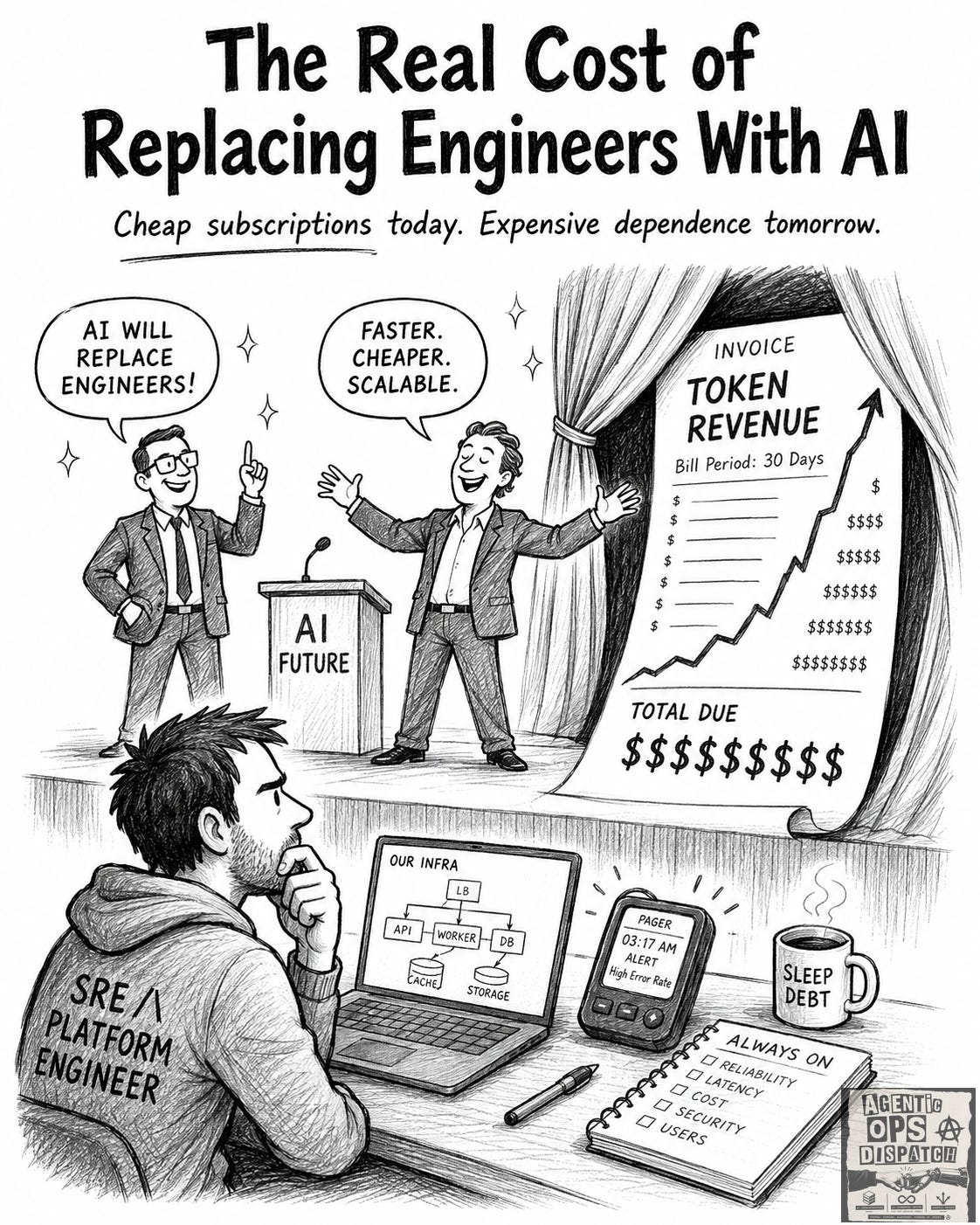
Signal Over Hype #01 - AI CEOs want you to compare a $200 subscription with a senior engineer. Production has a more expensive calculator.

AI CEOs are selling labour replacement using subscription prices. The pager, the token meter and the outage report tell a different story.
The newest AI employee apparently costs $20, $100 or perhaps $200 a month.
It writes code. It analyses logs. It creates Terraform. It investigates incidents. It never sleeps, never asks for a promotion and never complains about being on call.
Place that next to the salary of a senior SRE, DevOps engineer or platform engineer, and the conclusion appears obvious:
The engineer is an expensive legacy interface. The agent is the future.
There is only one problem.
The comparison is economically meaningless.
A flat-rate AI subscription is the price of giving one person access to a model under usage controls. It is not the cost of operating an autonomous production worker that continuously reads telemetry, retrieves context, invokes tools, retries failed actions, validates results, maintains state, produces audit evidence and remains available during an incident.
Replacing an engineer means replacing more than the visible actions they perform.
You must replace the work, the context, the judgement, the coordination and the accountability.
Once we calculate that system honestly, the $200 AI employee starts looking less like an employee and more like a heavily discounted demonstration.
Welcome to Signal Over Hype
This is the first edition of Signal Over Hype, a new Agentic Ops Dispatch series for DevOps, SRE, platform, infrastructure and AI engineers.
The purpose of this series is not to dismiss AI.
I use these systems every day. I believe AI will automate a substantial portion of operational work. Engineers who learn to work effectively with agents will have a serious advantage over those who ignore them.
But engineers are increasingly being asked to make career, architecture and workforce decisions in an environment filled with vendor incentives, executive predictions, benchmark theatre and social-media fear and FOMO.
In each edition, we will take one popular claim and examine it using:
Facts.
First principles.
Production experience.
Economic incentives.
And ordinary engineering common sense.
The recurring question will be simple:
What remains true after the keynote ends and the system has to run in production?
The job-displacement claim is not imaginary
In May 2025, Anthropic CEO Dario Amodei warned that AI could eliminate half of entry-level white-collar jobs within one to five years and push unemployment significantly higher. The statement was framed as a warning rather than a celebration, but it contributed to a powerful narrative: organisations should prepare for rapid labour replacement because the technology is moving faster than workers or governments realise.
It would be foolish to dismiss this simply because the prediction came from the CEO of an AI company.
The models are improving quickly.
METR’s research has found that the difficulty of software tasks frontier agents can complete with 50% reliability has increased rapidly over several years. Its researchers originally estimated a doubling in the measured task horizon roughly every seven months. METR also stresses an important qualification: this measures the difficulty of a task based on how long a human would take to complete it. It does not mean that an AI agent can safely run unattended in production for that many hours.
There will be displacement.
Some teams will become smaller. Some entry-level activities will disappear. Some companies will use AI to reduce hiring. Others will use AI as the explanation for cuts they already wanted to make.
But we should also notice that the industry narrative is not uniform.
OpenAI’s own 2025 employment paper said that the evidence available at the time pointed towards AI helping developers do more rather than simply replacing them. Anthropic’s 2026 labour-market research similarly reported limited evidence of broad employment effects so far, although it found suggestive evidence that hiring of younger workers may have slowed in highly exposed occupations.
That is the signal:
AI can perform more engineering work, and the labour market is beginning to adjust.
The hype begins when we jump from that observation to:
A $200 subscription can replace an SRE.
The first trick: compare a seat licence with a salary
Claude Max currently offers an individual plan priced at $200 per month with higher usage capacity than its standard plans.
That is real.
It is also almost entirely irrelevant to the cost of replacing an engineer.
Anthropic describes the Max plan as an individual-user product. It separately states that Claude subscriptions and Claude API usage are different products with different billing. Additional API or usage-credit consumption is charged independently of the subscription.
This distinction matters.
A person using Claude Code interactively is not the same workload as an autonomous operations platform.
A person chooses a task, provides context, waits for the result, inspects the answer and stops when the work is complete.
A production agent may:
Wake up for every alert.
Read logs, traces, dashboards, manifests, tickets and runbooks.
Send much of that context back to the model at every reasoning step.
Launch parallel subagents.
Retry failed tool calls.
Ask another model to review the first model.
Retain state across a long-running incident.
Create an evidence trail for every action.
Operate when nobody is watching.
And escalate to a more capable model whenever the cheaper one becomes confused—which, as production engineers know, is usually shortly before the dangerous part.
The $200 plan is not deceptive.
It is simply the wrong unit for the comparison.
Comparing an AI seat licence with the salary of an engineer is like comparing the price of Microsoft 365 with the cost of running the finance department.
The viral 320-million-token receipt
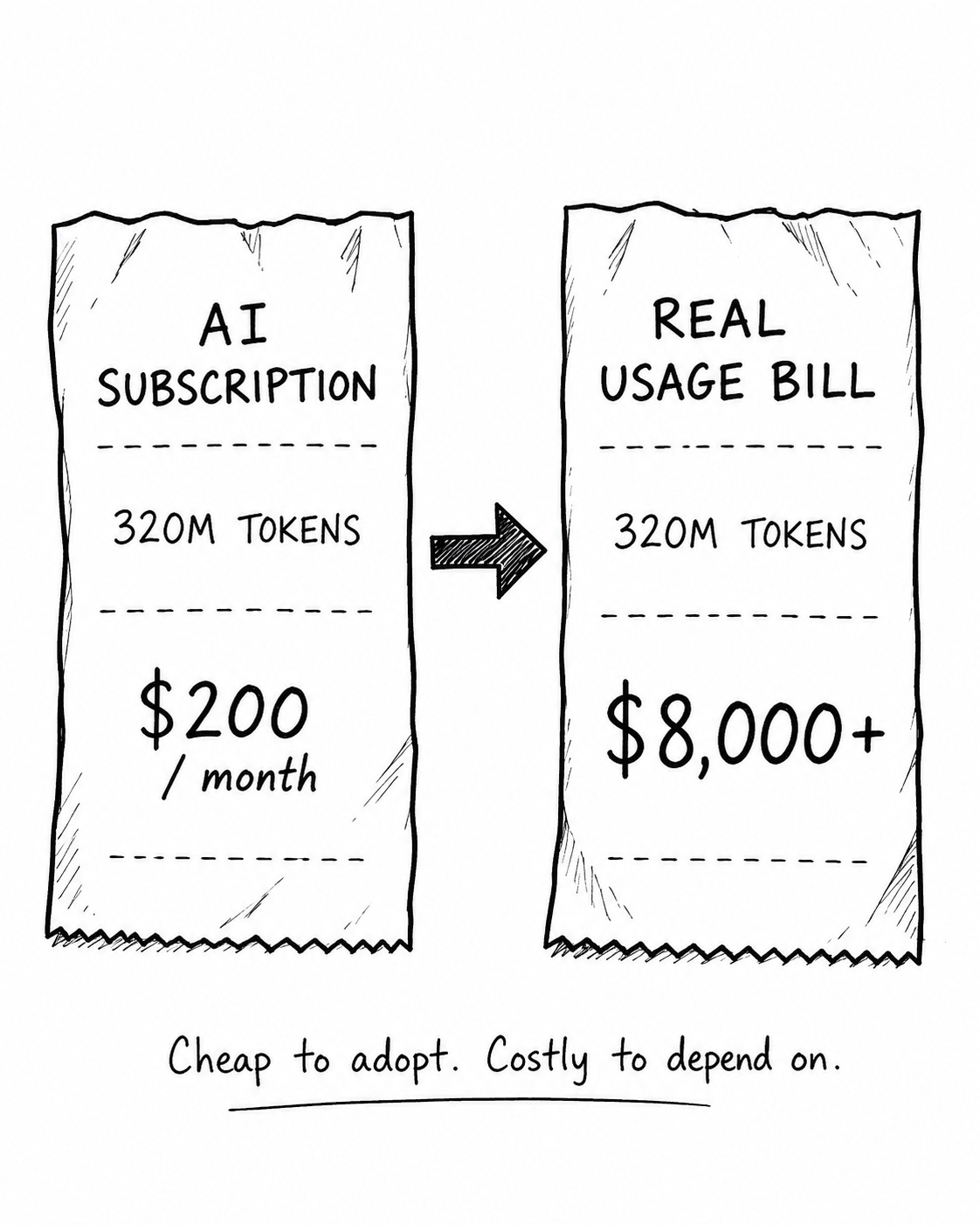
The image that inspired this article compares a $200 Claude subscription with an $8,000 API bill for 320 million tokens.
The arithmetic can be correct under a particular assumption.
Anthropic currently lists Claude Opus 4.8 at $5 per million input tokens and $25 per million output tokens. At those rates, 320 million output tokens would indeed cost $8,000. The same number of input tokens would cost $1,600.
But “320 million tokens” by itself is not a workload description.
You need to know:
Which model was used?
How many tokens were input versus output?
How much repeated context was cached?
How many tool results were added back into the conversation?
How many retries occurred?
How many agents operated in parallel?
Was the workload interactive, batched or long-running?
Was an expensive model used for everything, including tasks a smaller model or a twenty-line script could have handled?
Using the published Opus rates, a workload containing 90% input and 10% output would cost roughly $2,240 for 320 million total tokens—not $8,000.
A cheaper model could reduce it further. Prompt caching and batching could reduce some costs again. Poor context management, excessive retries and uncontrolled subagents could send them in the opposite direction.
So the honest conclusion is not:
Your $200 subscription secretly costs $8,000.
The honest conclusion is:
A subscription price tells you almost nothing about the cost of a production agent until you define the model, input-output ratio, context, caching, concurrency, retry behaviour and workload.
That is less viral.
It is also true.
Anthropic’s own Claude Code documentation says enterprise deployments average around $150–$250 per active developer per month, although costs vary significantly with model choice, codebase size, automation and concurrent usage.
That is important counterevidence.
Useful AI assistance can be economically attractive.
But notice the unit again:
Per developer.
That is the cost of augmenting a human.
It is not the cost of replacing the organisational function that the human performs.
An SRE is not a command-typing machine
The original SRE concept was never based on paying humans to repeat shell commands forever.
Google defines toil as repetitive, predictable and automatable operational work. Its SRE organisation has historically aimed to keep operational toil below half of an engineer’s time, leaving at least 50% for engineering work that reduces future toil or improves reliability, performance and utilisation.
In other words:
Automating operational work is not the destruction of SRE. It is the job of SRE.
The role includes:
Designing systems that fail safely.
Defining SLOs and error budgets.
Building delivery and rollback mechanisms.
Reviewing production readiness.
Managing capacity and cost.
Improving observability.
Coordinating incidents.
Understanding dependencies.
Negotiating risk with product and business teams.
And creating systems that need less human intervention over time.
A model can generate a kubectl command.
That is not the same as knowing whether the command should be run.
It does not automatically know whether the evidence is complete, whether the operation is reversible, what the blast radius is, which customer commitment is at risk, whether the database can tolerate the failover or who has authority to accept the consequences.
The pager is not requesting text generation.
It is requesting ownership.
The five real costs of replacing an SRE
1. Model access
This is the cost everyone talks about:
Input tokens.
Output tokens.
Reasoning tokens.
Cache reads and writes.
Tool-call context.
Web searches.
Multimodal input.
Retries.
Parallel agents.
Background jobs.
And escalation to premium models.
It may still be much cheaper than an engineer’s salary.
That is entirely possible.
But it is only the first line of the bill.
2. The execution harness
A production agent requires an operating environment around the model.
You need identity and access control.
Secrets management.
Tool or MCP gateways.
Policy enforcement.
Approval workflows.
State and memory.
Scheduling and event triggers.
Sandboxed execution.
Model routing.
Evaluations.
Observability.
Audit logs.
Rate and cost limits.
Rollback mechanisms.
Provider failover.
And a way to stop the agent when it begins confidently fixing the wrong problem.
Google’s SRE guidance describes automation as a force multiplier, not a panacea. Thoughtless automation can create as many problems as it solves.
LLMs make this principle more important, not less.
Traditional automation is generally wrong in repeatable ways.
Probabilistic automation can be wrong creatively.
3. Human review
Automation does not eliminate labour whenever someone must inspect, approve or correct its output.
A more useful formula is:
Net automation value = labour avoided − review labour − correction labour − platform cost − expected failure cost
Suppose an agent saves an engineer forty minutes.
It then requires twenty minutes of review.
Once every ten runs, it creates an hour of correction work.
The productivity benefit is not forty minutes.
And that is before accounting for infrastructure, token usage, security controls and context switching.
Research on AI productivity is not one-directional.
DORA’s 2024 findings associated AI adoption with improvements in individual productivity, flow and job satisfaction, while also finding negative relationships with software delivery stability and throughput. Its 2025 work described AI more positively as an amplifier of the surrounding organisational system: strong teams benefit more, while weak processes become faster at producing downstream chaos.
METR’s 2025 study of experienced open-source developers found that participants took 19% longer when permitted to use AI tools on mature projects they understood well. Strikingly, the developers believed they had become faster.
Both results can be true.
AI can accelerate well-scoped work while slowing experts in high-context environments where prompting, reviewing, correcting and steering the tool becomes expensive.
Production operations is one of the highest-context environments we have.
4. Failure and blast radius
A wrong answer in a document creates editing work.
A wrong production action can:
Delete data.
Expose credentials.
Break routing.
Corrupt state.
Increase cloud spending.
Violate a regulatory control.
Extend an outage.
Or create a second incident while attempting to resolve the first.
Uptime Institute’s 2026 analysis found that 57% of respondents said their most recent major outage cost more than $100,000. One in five said it exceeded $1 million.
You do not need many autonomous-agent mistakes at that price before the salary comparison starts looking childish.
The expected failure cost is not:
Probability of a model error × cost of an API request.
It is:
Probability of an unsafe decision escaping your controls × business impact of the action.
That is why dry runs, bounded permissions, staged execution, canaries, approvals and rollback are not bureaucratic additions.
They are part of the product.
5. Knowledge and accountability
Experienced engineers hold knowledge that is only partly documented.
Why does the architecture look unnecessarily complicated?
Because the simpler version failed during a peak event four years ago.
Why has nobody removed that temporary workaround?
Because it quietly became load-bearing.
Why is one alert routinely ignored?
Because it lies.
Why is another apparently harmless warning taken seriously?
Because it appears fifteen minutes before the system collapses.
Which customer cannot tolerate a five-minute disruption?
Which deployment order is dangerous?
Which dashboard stays green during the precise failure you fear?
An AI system can retrieve recorded knowledge.
It cannot reliably retrieve what the organisation never recorded.
If a company removes engineers before converting that knowledge into runbooks, executable skills, tests, policies, dependency maps and incident history, it is not eliminating cost.
It is deleting state.
Accountability is harder still.
NIST’s generative-AI risk guidance recommends defining human-AI responsibilities, applying suitable human oversight, and maintaining review, tracking and documentation appropriate to the risk.
When an agent recommends deleting a cluster, who approves the decision?
When it is wrong, who owns the incident?
When the regulator asks who accepted the risk, do we provide the model ID?
Follow the money—but do not invent a conspiracy
It is tempting to tell a neat story:
AI companies are subsidising subscriptions now.
They want organisations to become dependent.
Once companies fire their employees, token prices will rise.
The vendors will collect the difference forever.
Parts of this are plausible.
The full story is not yet proven.
Technology companies frequently use flat-rate plans, free tiers, credits and generous usage limits to accelerate adoption. Production workloads then move towards metered infrastructure, enterprise contracts and consumption-based billing.
But model prices can also fall as hardware, inference software and competition improve. Customers can route workloads to cheaper models. Caching and batching can reduce costs. Open models and local inference create alternatives.
The stronger, evidence-based argument is this:
Subscription access and API consumption are different products.
Production automation tends to expose real usage costs.
Operational integration creates switching costs.
And once your company’s runbooks, workflows, memory, tooling and approvals are built around one provider, that provider gains commercial leverage—even when the cost per token falls.
The largest risk is not necessarily that a token becomes more expensive.
The risk is that your organisation becomes unable to operate without a particular model, memory format, proprietary agent runtime or vendor-controlled tool ecosystem.
We have seen this movie before.
This time the lock-in comes with a friendly chatbot.
What will actually be automated
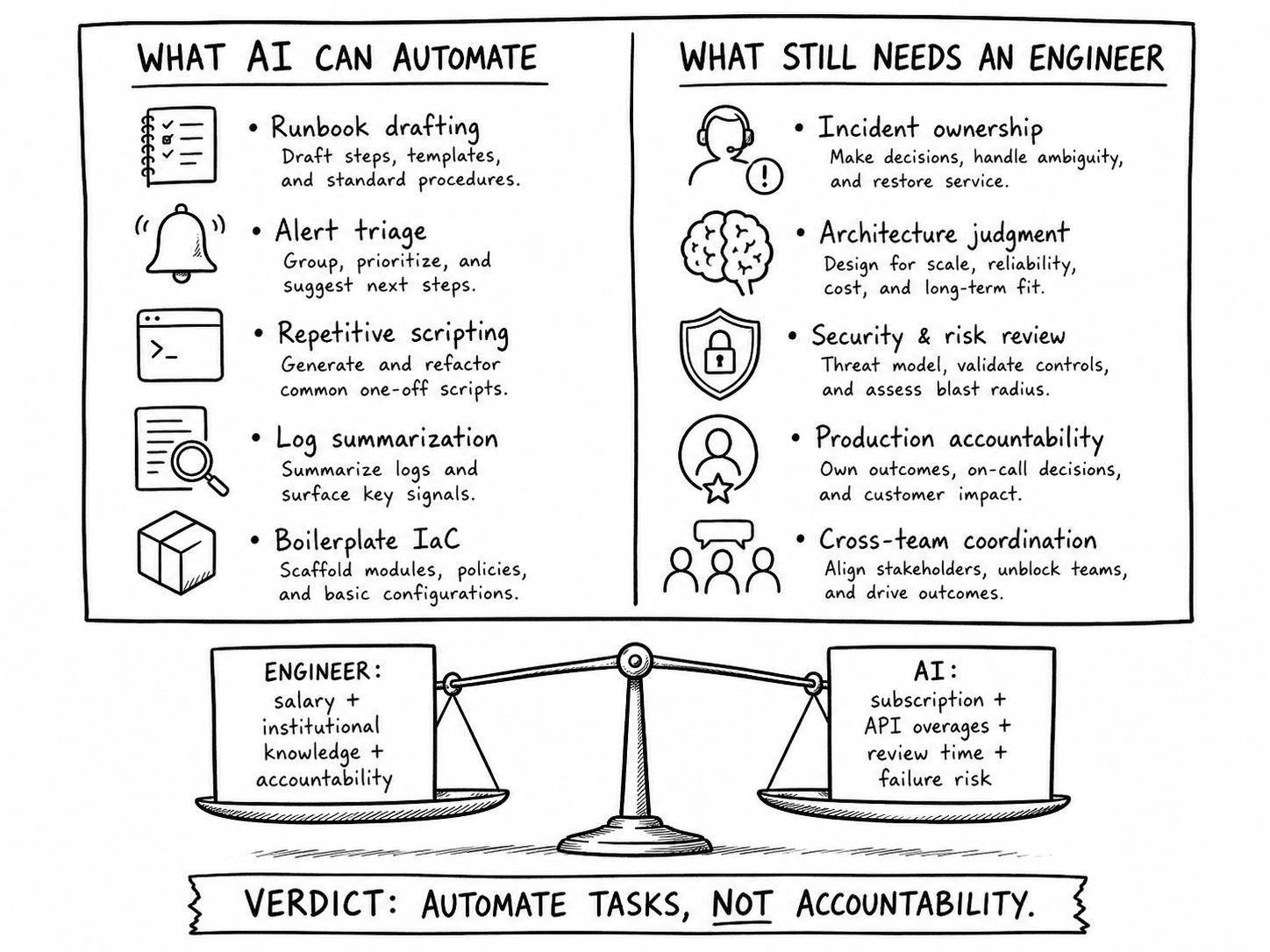
A large portion of today’s operational toil is highly automatable:
Alert enrichment and deduplication.
Log and trace summarisation.
Incident timeline construction.
Runbook drafting.
Routine script generation.
Configuration and policy checks.
Change preparation.
Documentation.
Dependency lookup.
Ticket triage.
Known-issue diagnosis.
Post-incident summaries.
Capacity analysis.
And execution of constrained, reversible procedures.
Some of this should use frontier models.
Some should use smaller or local models.
Some should use conventional code.
Calling the most expensive model available to parse a known JSON document is not AI-native engineering.
It is a refusal to write twenty lines of Python.
The goal is not maximum AI usage.
The goal is the minimum reliable cost for the required outcome.
What should remain human-led—for now
Most serious organisations should continue to keep human ownership around:
Incident command.
Architecture decisions.
Reliability and cost trade-offs.
Risk acceptance.
Security-sensitive changes.
Ambiguous diagnosis.
Cross-team coordination.
Customer communication.
Novel failure modes.
Regulatory accountability.
And any action whose blast radius exceeds the system’s ability to recover safely.
The boundary will move.
Agents will become more capable. Evaluations will improve. Organisations will gather successful production history. Permissions and policies will become more granular.
But the correct way to move this boundary is through evidence:
Tested historical incidents.
Measured success rates.
Controlled production deployments.
Bounded permissions.
Demonstrated rollback.
And clear escalation paths.
Not because an executive said the future was arriving next quarter.
Can AI reduce the size of an SRE team?
Yes.
That is an entirely reasonable outcome.
A smaller team may be able to operate a much larger estate by using AI for diagnosis, change preparation, routine remediation, documentation and operational analysis.
AI may reduce the number of engineers needed for some kinds of systems.
But this becomes responsible only when:
The service has clear SLOs.
Operational knowledge is documented.
Common incidents have tested runbooks.
Deterministic actions use deterministic code.
Agent permissions are narrowly scoped.
High-risk actions require approval.
Changes are staged and reversible.
Telemetry is trustworthy.
The agent is evaluated against historical incidents.
Costs are measured end to end.
Humans can take control.
And the remaining team has enough capacity to improve the system instead of spending every day supervising bots.
It is not responsible when the organisation has:
Weak observability.
Undocumented systems.
Shared administrator credentials.
Unreliable tests.
No rollback process.
No incident-command discipline.
Unclear ownership.
And a management strategy that can be summarised as:
Claude will figure it out.
The more chaotic the environment, the more impressive an AI demonstration can appear.
It is also the environment in which autonomous execution is most dangerous.
The architecture that makes economic sense
The sensible Agentic DevOps architecture is not:
Send every operational event to the largest frontier model available.
It is layered.
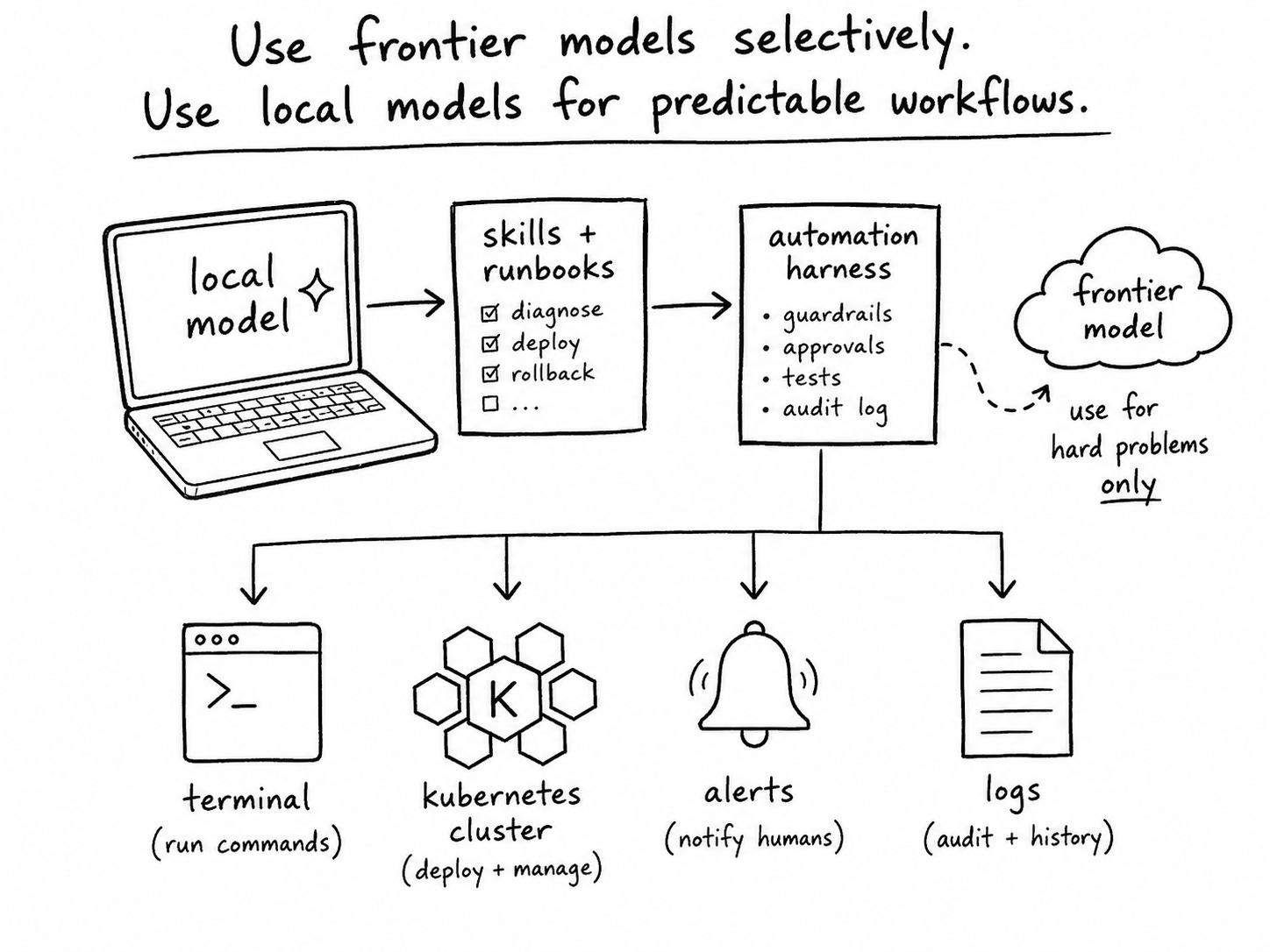
Deterministic code for deterministic work
Use scripts, APIs, controllers, workflow systems and policy engines when the rules are known.
A model does not need to decide how to restart a service when the procedure is already deterministic, tested and safe.
Skills for reusable operational knowledge
Convert runbooks and procedures into versioned skills containing:
Instructions.
Scripts.
Expected evidence.
Preconditions.
Tests.
Permissions.
Escalation rules.
And rollback steps.
This turns institutional knowledge into a portable operational asset rather than a collection of documents an agent may or may not interpret correctly.
Smaller or local models for predictable cognition
Use efficient models for:
Classification.
Extraction.
Routing.
Summarisation.
Known-pattern diagnosis.
And low-risk decision support.
These workloads do not always need frontier reasoning.
Frontier models for genuinely hard problems
Use the most capable models when ambiguity, novel incidents, architecture analysis or complex synthesis justifies the additional cost.
The expensive model should be an escalation path.
Not the default parser for every log line.
A governed execution harness around everything
Add:
Identity.
Policy.
Approvals.
Observability.
Evaluations.
Budgets.
Audit.
Isolation.
Rollback.
And human escalation.
This architecture reduces dependence on any one model vendor.
It also allows the organisation to improve its operational system while models continue to change.
Models are replaceable components.
Your skills, telemetry, controls and institutional knowledge are the durable assets.
The verdict
AI will change SRE, DevOps and platform engineering profoundly.
It will eliminate toil.
It will compress some roles.
It will allow smaller teams to run larger systems.
It may eventually operate significant production environments with limited human supervision.
But replacing an SRE with a chatbot subscription is not transformation.
It is an accounting illusion.
The real comparison is not:
Engineer salary versus AI subscription.
It is:
The fully loaded cost and risk of a human-led engineering system versus the fully loaded cost and risk of an AI-led engineering system.
Sometimes the AI-led system will win.
Frequently, the best answer will be a smaller and stronger engineering team operating a well-governed automation platform.
And in immature organisations, removing the engineers first may be the most expensive decision of all.
So automate aggressively.
Measure token consumption.
Measure review time.
Measure failed actions.
Build reusable skills.
Use local models where they are sufficient.
Use frontier models where they earn their cost.
Require human approval where the blast radius demands it.
But do not fire the people who understand production because somebody compared their salary with the promotional price of a model subscription.
Fire the toil. Keep the SRE. Modernise the pager.
Because the pager does not care about the keynote.
And when it rings at 3:17 in the morning, somebody still owns the outcome.
About Signal Over Hype
Signal Over Hype is an Agentic Ops Dispatch series, curated by Gourav Shah, examining the claims shaping DevOps, SRE, platform engineering, AI infrastructure and agentic operations.
No reflexive optimism.
No reflexive pessimism.
Just facts, incentives, first principles and production reality.
Sources and further reading
Anthropic, “Choose a Claude plan” and documentation covering subscription versus API billing.
Anthropic, Claude Platform pricing and Claude Code cost guidance.
Anthropic, “Labor market impacts of AI: A new measure and early evidence,” March 2026.
OpenAI, “Jobs in the Intelligence Age,” September 2025.
METR, research on AI task-completion horizons and experienced developer productivity.
DORA, 2024 and 2025 research on AI-assisted software development.
Google, Site Reliability Engineering: “Eliminating Toil” and “The Evolution of Automation at Google.”
NIST, Artificial Intelligence Risk Management Framework: Generative Artificial Intelligence Profile.